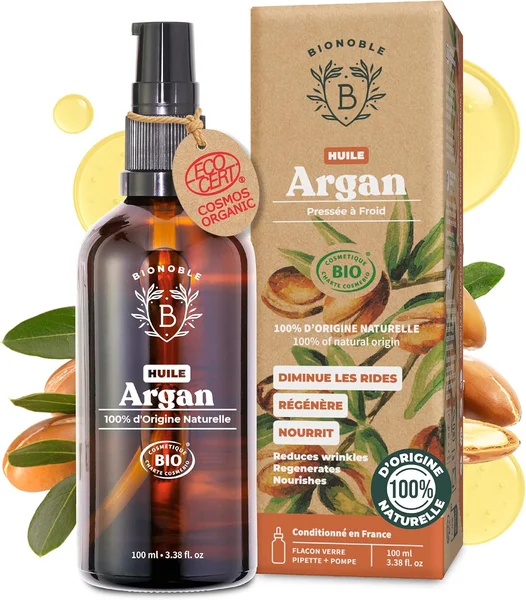
Organic Argan Oil: Reading Labels and Avoiding Scams
Discover how to decode ECOCERT, USDA, and Cosmos labels on organic argan oil, avoid marketing traps, understand the INCI, and choose quality at the right price.
Organic argan oil is a treasure of natural cosmetics, prized for its nourishing and regenerating properties. But with the multiplication of offers, it becomes essential to know how to read labels, understand the INCI composition, and recognize marketing traps to avoid scams. This comprehensive guide helps you choose an authentic, quality organic argan oil while respecting your budget.
Organic labels guarantee that the argan oil meets strict criteria for production, processing, and labeling. Here are the three main labels to know:
1. ECOCERT
ECOCERT is a French certification body highly recognized in Europe. To obtain this label, the argan oil must come from organic farming that respects the environment, without pesticides or chemical fertilizers. ECOCERT also verifies manufacturing processes, notably the absence of chemical additives.
Minimum 95% organic ingredients in the finished product.
Respect for good environmental practices.
Regular and rigorous inspections.
2. USDA Organic
The USDA Organic label is awarded by the U.S. Department of Agriculture. It certifies that the oil comes from verified organic farming. This label is internationally recognized, but the criteria may differ slightly from ECOCERT.
Farming without synthetic pesticides.
No GMOs.
Certification throughout the entire production chain.
3. COSMOS
The COSMOS label is a European standard dedicated to organic and natural cosmetics. It is recognized by several European bodies (including ECOCERT). COSMOS guarantees not only organic cultivation but also strict compliance with product composition, excluding harmful synthetic ingredients.
At least 95% natural or naturally derived ingredients.
At least 20% organic ingredients (10% for rinse-off products).
Ban on parabens, silicones, PEGs, synthetic fragrances.
Decoding the INCI: Understanding the Composition of Argan Oil
The INCI (International Nomenclature of Cosmetic Ingredients) is the official list of ingredients on the label. For pure argan oil, you should find:
Argania Spinosa Kernel Oil: the botanical name for argan oil.
Possibly "organic" or "bio" if the product is certified.
Beware of blended or refined oils. Pure argan oil should not contain other vegetable oils, chemical preservatives, or additives. If you see terms like "fragrance," "natural fragrance," "tocopherol" (synthetic vitamin E), or chemical names, this may indicate a processed or blended product.
Common Marketing Traps to Avoid
The argan oil market is subject to many deceptive practices. Here are the main marketing tricks to watch out for:
1. The Uncertified "Organic" Label
Some products proudly display "organic" without an official label. This term is free and unprotected: it may be an uncertified or even conventional oil. Always ask for certification (ECOCERT, USDA, COSMOS).
2. Blended or Refined Argan Oil
To increase volumes or reduce costs, some manufacturers blend argan oil with cheaper oils (sunflower, jojoba) or refine it, which destroys its properties. Pure oil is generally cold-pressed and unrefined.
3. The "100% Natural" Marketing
The term "natural" is not regulated. A product can be natural but not organic or contain processed ingredients. Organic certification is the most reliable guarantee.
4. Low-Priced "Cosmetic" Argan Oil
Quality argan oil is expensive due to harvesting and artisanal production. A price that is too low often indicates inferior quality or diluted oil.
Price and Quality: How to Make the Right Choice?
The price of organic argan oil generally ranges between 20 and 50 euros for 50 ml, sometimes more for very high-end oils. Here are some tips to choose well:
Favor small certified Moroccan producers or cooperatives. They often guarantee better quality and fair trade.
Check the type of packaging. Argan oil should be sold in tinted glass bottles (amber or cobalt blue) to protect from light.
Prefer cold-pressed, unrefined oils. They better preserve their active ingredients.
Compare labels and certifications. A product with ECOCERT and COSMOS reassures on organic and natural quality.
Beware of big promotions or very low prices. Quality has a cost, especially for a rare and precious oil like argan.
Storage: Preserving the Benefits of Organic Argan Oil
To keep argan oil’s properties intact, follow some simple rules:
Store it away from light and heat. A tinted glass bottle is ideal.
Avoid exposure to air. Close the cap tightly after each use.
Keep it in a cool place, between 15 and 25 °C. Avoid sudden temperature changes.
Do not keep it too long. Quality argan oil keeps for about 12 months.
If the oil smells rancid, discard it. An unpleasant odor signals oxidation and loss of effectiveness.
Conclusion
Choosing an authentic organic argan oil requires vigilance. ECOCERT, USDA, and COSMOS labels are reliable guarantors of organic and natural quality. Learning to read the INCI helps avoid blends and unwanted additives. Finally, beware of marketing traps and prices that are too low, which may hide lower-quality products. By following these tips, you will fully enjoy the exceptional benefits of organic argan oil with complete confidence.
 FR
FR EN
EN